

Time to Think Outside the Box
Sonoma County Peace Press, May 1, 2026
Public Input Needed for a More Equitable Vision for the South Santa Rosa Specific Plan
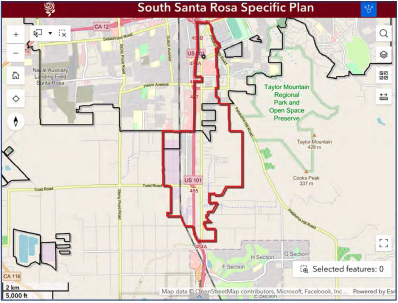
Santa Rosa is in the midst of a planning process for the Santa Rosa Avenue area called the South Santa Rosa Specific Plan (SSRSP.) The webpage has a tab at the top where it can be changed to Spanish. The SSRSP is equivalent to a 1960s urban renewal project where low-income, mostly people of color, were displaced. The whole SSRSP area qualifies as a disadvantaged community and this can be clearly seen by studying a series of maps I put together on my Substack. When the public makes an investment to “revitalize” an area, land values and investment opportunities rise and this is what causes gentrification and concomitant displacement, especially of vulnerable populations who will not be able to afford inflated prices. The city has anticipated this displacement with a displacement strategy document.
What is happening now in the SSRSP is an outreach process where the public is being asked to choose a Plan Alternative. You can read the Alternatives Report here and take the survey on it here. The full Alternatives Report is only in English but an abbreviated Report in Spanish can be seen here, and the survey can be taken in Spanish here.
The Alternatives Report and survey give no indication of any plan downsides. The choices appear to be just about land use and transit, even as the whole process has predictable negative displacement and higher cost of living consequences for the 53 percent Latinos, and many mobile home park and lower-income residents, in the plan area.
Some alternative options do provide advantages for current low-income areas, for example a possible commercial center in Moorland and a pedestrian/ bike Highway 101 over-crossing at Robles and Bellevue Avenues. By studying the alternative maps and charts, you can be better informed to take the survey, draw your own conclusions, and also make your own hybrid plan where you say what you’d like to see in the SSRSP. You are not limited by the options provided by the city.
The purpose of this article is to encourage people to think outside the box and, should you take the survey or get involved in the plan, to focus on the social justice aspects and ask the city to address these things up front and center.
The thing about many city plans, policies, and mitigations to protect low-income people, is that the language sounds good but is largely aspirational and doesn’t really obligate anything with teeth gets done. There are stronger steps that could be taken, rent control, just cause eviction, a strengthened mobile home park Closure and Conversion Ordinance backed by Legal Aid, etc., but these sorts of things take political will and spine to resist lobbying by the investor and landlord classes.
As well, Affirmatively Furthering Fair Housing (AFFH) is mandated by state law (AB 686) to combat housing discrimination, overcome historic patterns of segregation, and eliminate racial/economic disparities in housing access. It requires public agencies to take meaningful actions to foster inclusive communities and increase access to opportunity. The city should be reminded in your survey answers that AFFH should be strongly pursued in the SSRSP.
What it all boils down to, is that business as usual growth and economic development operate in a manner that tends to create inequity. This is why we see Two Americas, and the haves and have-nots world-wide. What we need in Santa Rosa and Sonoma County is more AOC and Zoran Mamdani-type municipal socialism, to temper the excesses of the market. Milton Friedman said that business’ job is to make a profit and the government’s job is to act as the backstop for business/ market excesses.
The SSRSP is the perfect stage for the public to ask our local government for a more progressive approach to planning, one that puts the interests of the little guys on an equal playing field. Fred Allebach is Co-Chair of the Santa Rosa-So